Showing posts with label AVAE. Show all posts

11.10.2010

Rehearsal notes 11/8 and 11/9--Robert Kyr/Ryan Heller

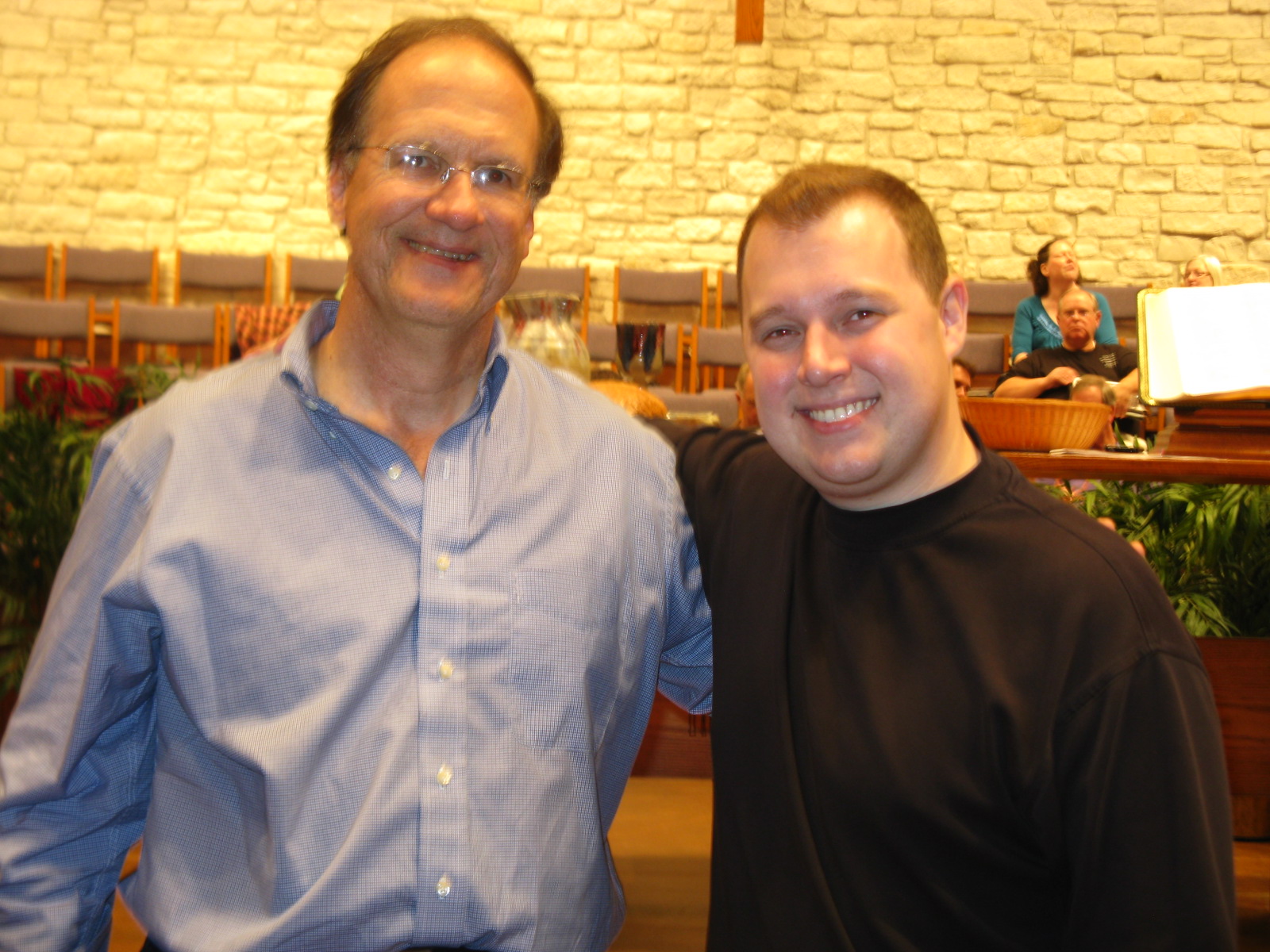
Composer Robert Kyr, Musical Director Ryan Heller

11/8/10--Last night's rehearsal was at the Oak Hill United Methodist Church in the sanctuary where we will perform. It went well, the group really pulling together. Very comforting to get a feel for the acoustics--how to listen and how to produce sound for that space. The Very Big Deal, however, was Tuesday night's rehearsal.

11/9/10--Composer Robert Kyr, whose "Let There Be Music" is featured on the program, worked with the ensemble this evening, and will be in attendance both performances. He was most enthusiastic about the preparation we'd done under the direction of Ryan Heller, AVAE's musical director.

We had an exhaustive, exhausting, fabulous time regrouping to the physical architecture of the piece. He gave us valuable insight into the piece on common ground and supercharged the response of the chorus. Kyr, professor of composition and theory at the University of Oregon, morphed rehearsal into a master class.

Firstly, we did a few minutes of yoga, although he didn't call it that. Progressive upward stretches to release the tension in the vocal mechanism to produce our best sound. And that it did. I think we all listened "with bigger ears," as Ryan said, and certainly put that piece (mostly--a few things to work out Thursday) where it needs to go. I love working with composers--and they love hearing their work done the way they want it done. And done, in Watermelon Sugar.

From Kyr: "overtones are the DNA of music..." "think of a double helix when you sing these interweaving lines..." let there be music--let there be light--let there be breath." The piece is quite sonorous. It is also quite visual. It will be a great treat for everyone, audience and performers alike.

Regrouping the architecture: Yes, we physically did this--moved the ensemble right out front in 2 lines, with the various voice sections re-positioned. Kyr explained the specific structures to the group, and placed sections that interweave closer together. It makes sense in this piece. We learned what to listen for, and we listened better. And the closer we are to the audience, the more involved they will be.

That's what music is, after all. Equal parts listening and singing/performing. It's the magic of chamber ensembles. The most interesting (to me) choral music and certainly the biggest challenge. I'd like to see all my friends and relatives there, and lots of new folks who love music and are interested to hear a fabulous ensemble perform wicked-good stuff.

Visit Chorus Austin for concert details and tickets.

11.16.2008

Meme is not just a musical warm-up exercise

Kay at Kay's Thinking Cap tagged me with that meme. You know, the one that asks you to reveal all the sordid, mucky details you've swept under the rug about yourself. The one about your ex- that makes it to the top of Google rankings and gets you into a world of trouble.

Just kidding. I don't have secrets. I just have multiple lifetimes of juicy living. And no more than half are X-rated. Yet.

Back to the meme. I'll be tagging some folks, irritating the heck out of some of them, I'm sure. It's kinda like getting those "send this 'friends forever' cutesy poem to everyone in all your address books in the next ten minutes or your cat goes in the river" e-mails.

Memes do two things for me, though. They usually call for at least a brief moment of introspection, which is usually a good thing. They also alert me to blogs that I usually fall in love with. When you're an elderblogger, you tend to meet exceptional people with interesting experiences and decent writing skills, messing around in non-traditional media (for that age group).

When I wrote as The Good Musician, I posted some pearls of wisdom from Margaret Hillis, long-time conductor of the Chicago Symphony Chorus. The coolest thing happened. One of the comments was from a person who adjusted my faulty memory regarding the specific performance in the conversation. It was a thrill to correspond with someone else who had worked for her and appreciated her as much as I did. I savor the essence of music distilled by a lifetime of peak musical experiences. Then share that joy with other music lovers as often as possible. Doesn't have to be classical. I still get turned on by CSNY, tears my heart out. Standing 6 feet from Janis onstage at the Texas International Pop Festival (whole roll of photos--her gorgeous purple and blue outfit), begging me to take another little piece...

Geez, haven't even gotten into the meme yet. Guess I'm not s'posed to yet. Still sore from the concert last night, still have those tone clusters in my head, still awash in the ethos. Doing my own internal debriefing. Music reviews 'R Us.

There are several key components to a vocal chamber ensemble performance, beginning well before the actual concert. Preparedness--how successfully did the group organize and learn not only the material, but how to make an ensemble sound--how to listen and blend. How to present a musical experience the composer would love. How to relate what the composer intended to the listeners. What do the words mean? How does the composer use music to emphasize that meaning? Above all, has the group found the natural phrasing of the piece? The flow that the composer heard?

Professionality--how well did the group commit to making the best sound 100% of the time? Not wasting time in chit-chat or non-essentials while the group has a few precious hours together to get the ensemble sound in their ears, the transitions, the modulations to smoothly connect sections. How willing are the singers to blend rather than blast, use their ears as part of their voice--it's all connected--all the same physical mechanism. The vocal chords vibrate the whole body, and the ears are right next to the throat. Use those vibrations to inform your sound production to sing dynamically correctly and in tune. Critical skills for a professional ensemble singer--you have to be willing to match pitch and diction with every other singer in your group, which requires both ears all the time. That's just for openers.

Performance practice--I don't mean how you get up and down from the stage. I mean are you aware of how the Baroque sound differs from the Romantic. It's a little like role-playing. Baroque instruments sound like this, so their technique of playing them would be like this. The instrument couldn't sustain a sound like a modern one does, so there would have been more separation between the notes in general, a lighter, sparer sound. You can go fairly bombasto in the Romantic. Deep, lush, gigantic orchestras, hefty singing. A conductor friend once said that when performing in the Baroque style, think lace. When doing Romantic, think velvet. Your voice has to make that distinction as well.

Experience--if you prepare properly, you can improve your sound. You can build your skills and get better. Over time, the piece will viscerally become part of you. Those vibrations will have imprinted on your body as well as memory. As you work on a piece over the years, you learn what to listen or look out for. You've memorized it long before now, so that you can swim in the flow with your fellow singers and conductors to really enjoy the music and the experience. It never stops building. The music becomes an old friend, and as such, it's more and more satisfying.

The Music Is The Thing. Not you, not your ego, not your neighbor's annoying habit of humming their part when another section is rehearsing theirs. A rehearsal no-no. Destroys focus and concentration. Do that outside of rehearsal. The sounds need to be in your ears and head before they can be sung well. You might even say it disrupts the harmony of the group (pun intended). It isn't about you. It's about sharing what the composer wrote and felt with someone else as authentically as you can, using proper technique and musicianship. The difference between playing notes and making music is proper phrasing. You have to find where the arrival points are and the most musical way to get there.

Meanwhile, I'm sore from holding up music, breathing deeply, using lots of muscles to support a dimenuendo fading to niente, a four hour round trip by car to Round Top, an up til 3 a.m. visit with my best friend from Princeton Thursday evening and Friday morning, and incomplete recovery from the Thursday night concert. It's time to get a cup of tea, take a couple of anagesic, and take a nap!

Kay, apologies for the side-track--I really will do the meme!

11.12.2008

Concert of Hope--AVAE performs 11/13/08

The Austin Vocal Arts Ensemble sings "Poetic Voices," settings by contemporary composers of Shakespeare, Donne, Spenser, and other greats tomorrow night at Hope Presbyterian Church 8:00 p.m. John McLean weaves the lush sounds of Vaughn Williams, dello Joio (who passed away this year after a long, productive life in music), Barber, and Whitaker, calling on the considerable talent in the ensemble. A big hug for Nick and Julie Boltz, music directors and fabbo singers/pianist. They hosted AVAE rehearsals as well, allowing the ensemble plenty of time to learn the music in a superb performance space.

This has been a lovely concert period, getting to know a new director and new singers. John (or Mac) is a musical dynamo, with a vast amount of knowledge, warm-up and rehearsal technique, and visceral understanding of the gestalt of music. His tempi are always intuitive, and he brings his singers into his aura to take particular care in their execution of the piece, on every level. We always have a comfortable, satisfying workout. Or at least I do, from how well the group sounds, I assume most everyone else does too.

There's a run-out concert at the Festival Institute at Round Top this Saturday. So if you don't catch the program here, you can take a nice drive in the country for the Choral Festival.

Now, to load up my black folder...

7.16.2008

It furthers one to find a good teacher--I Ching

Change is inevitable. You can frequently turn it to your advantage if you keep a sharp lookout. Other times you just have to sit and grieve over the loss of a situation you held dear. And then move on.

Decrypting, our choral director is retiring from our group to focus on his university duties. This is as it should be, and everyone is pleased for him, and grateful for the time he spent with us. He is truly a gifted rehearsal technician and director, and coaxed the ensemble to shine. I was privileged to participate in some uncommonly good music making, singing stuff I adore. He will be sorely missed. I look forward to participating with him and other colleagues at the 2009 Georgetown Arts Festival.

So tonight I'm articulating my appreciation for two of the good teachers I've had the opportunity to learn from and grow with as a musician.

I especially am honored to have experienced the totally awesome Central Europe tour with our director and his wife, who is an equally gifted artist and teacher. I learned much from her about digital photography, both through her gentle tutoring and by observing her interaction with all the glorious sights around us and what her eye was drawn to. She created some absolutely gorgeous mementos of those dazzling experiences for the group.

Thanks, Kenny. Thanks, Star.

5.24.2008

Digital cameras and the kitchen sink


Found some nice light the other afternoon. Here's what I saw--afternoon sun, my favorite crystals, a volunteer avocado plant.

The hail/lightning/wind storm fried my computer. I am exceeding all known equations of happiness to have it back safe and sound.

And to have a little time to take stock. Lots of transition at work, not good news on back, daily business, rehearsals piling up more than I would like.

In less than a month, I'll be schlepping a bag east to west from Budapest through Slovenia to Prague to Dresden to Leipzig to Frankfurt. Houston-London POE. Singing mostly gospel and colonial church music in the churches and cathedrals there.

So I'm delirious to have a few moments to practice with my wowie camera (present from my daughter) and get a grip on how the heck I'm going to negotiate ONE bag with concert gear (long, black 100%), music, personals, camera, and clothes for ten days. I saw a site that demonstrated "bundling," which I may try this time.

And to get back to Fried Okra Productions. I've missed it.

4.06.2008

AVAE's American Tapestry concert

The extended drought has severely limited the bluebonnets this year. As you can see from the photo, they're sparse. If we'd had enough rain last fall and winter, the frame would be filled with a deep saturated blue, with contrasting Indian Paintbrushes scattered throughout. They are companion plants, and you won't see one without the other, except perhaps in a drought. Few Mexican Blankets, either.

So what does any of this have to do with Austin Vocal Arts Ensemble, you may ask? Well, some of the best music happens during bluebonnet time, however lush or sparse the blooms. The concert was very satisfying, good crowd, pitch stayed up pretty well, although I hate flatting at all.

A new opportunity presented itself: I've been hired by b5media to blog as The Good Musician, and went live on March 31. I can still write about music on Fried Okra Productions, and am free to publish any post from TGM a month later. You might as well go over to TGM, check it out, give me your ideas, contacts, and critique. I'm open for suggestions--anything having to do with music.

Learning curve on WordPress, I like it. It will take a bit to get up to speed. I'd love to hear about WP tips or advice--anything to fine tune the digital media, it's a frisky pony at present.

8.29.2007

Yay for Brahms!


Johannes Brahms (1833-1897) was a musician's musician and composer. He practiced counterpoint (think Bach Two-Part Inventions) for two hours every day before he put pen to manuscript to compose his own work. I call him the hemiola king. Makes singing interesting. Basically, it's shifting the metric pattern from a 3/4 or 6/8 (triple) time signature to what sounds like a string of duples. In other words, you're banging along 1 2 3 1 2 3 and the accent shifts to 1-2 3-1 2-3. You have to hear it...

At any rate, tonight was first rehearsal of the season for the Austin Vocal Arts Ensemble (AVAE), and we're doing a full program of Brahms, featuring the Liebslieder Waltzes. Brahms' style was Classical Romantic, rather than full-out Romantic. He respected the older forms of music (imitation, canon, fugue, et al) and adapted them to structure his work, as opposed to say, Wagner, who wrote what is known as program music--sometimes called a tone poem--which tells a story, or conjures an image, and may be through composed, which simply means the architecture doesn't divide up into neat sections. Think Prelude and Liebestod--restless movement away from a tonal center, never quite landing on a cadence (think the A-men at the end of most hymns).

Brahms wrote for nearly every genre except opera. His lieder (songs) are de rigeur for any singer, and his piano pieces are difficult, but supremely satisfying--you get to use the full range of the piano, and thunder away all your anger or depression. The symphonies are quite pleasant, but perhaps his best known work is Ein Deutsches Requiem (The German Requiem) for chorus and orchestra, which regularly shows up in every chorus' season. It isn't religious so much as spiritual. His tonalities reach deep inside your psyche and resonate with exquisite passion for the listener and the singer.

If you are in Austin on November 8, come listen. You'll hear lots of hemiola :)